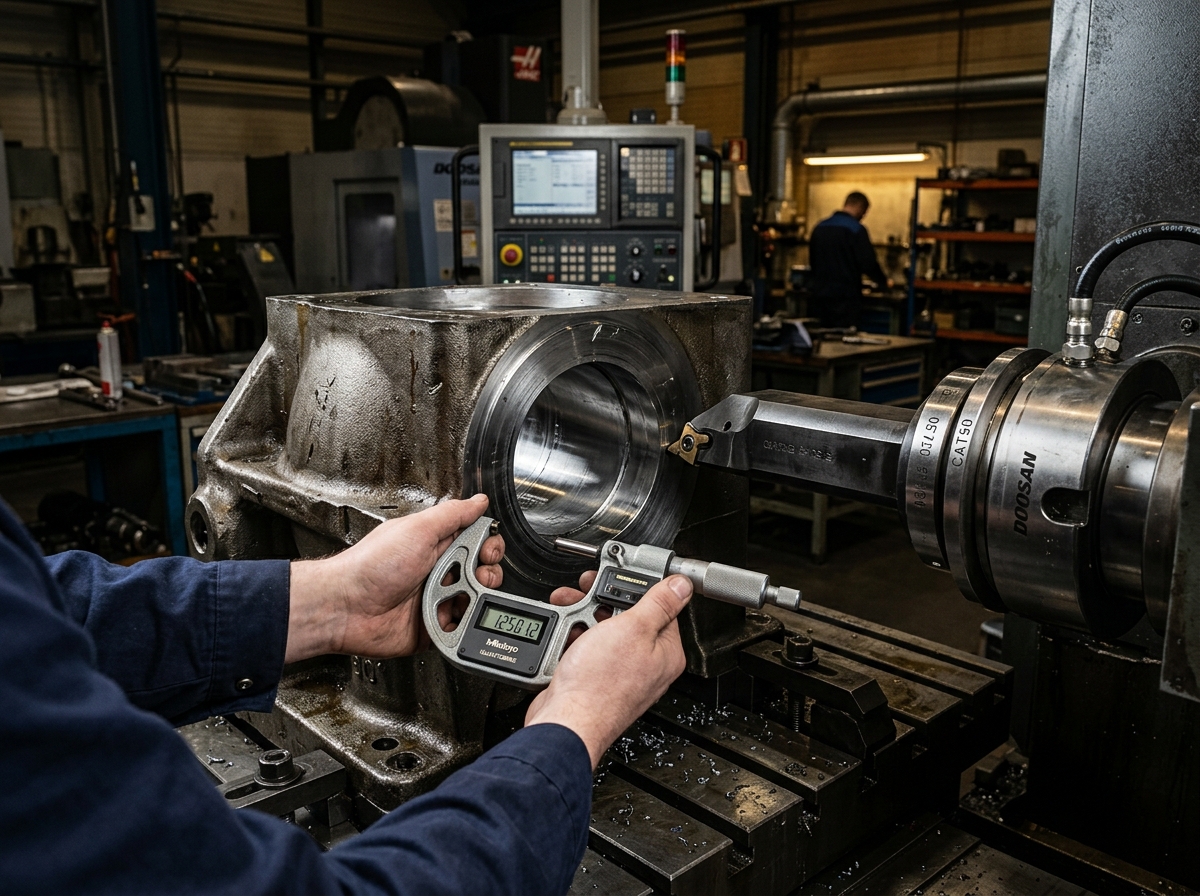
Large-Format Machining: Choosing the Right Partner for Oversized Components
DHANRAJ Engineering Team
The Large-Format Machining Problem
Most machining centres have a table size of 800 × 500mm or 1000 × 600mm. For the majority of components in manufacturing, this is entirely adequate. But across heavy industry — machine tools, defence, railways, mining, power generation — components regularly exceed these envelopes. When that happens, you need a specialist partner.
What to Look for in a Large-Format Machining Partner
Machine envelope is the obvious starting point. But envelope alone is not sufficient. A large machine with poor rigidity cannot hold tolerances under heavy cutting. Look for:
- Machine architecture — double column provides rigidity; single-column or bridge types may deflect under load.
- Spindle specification — BT-50 or equivalent for heavy tooling.
- Controller — reliable, proven CNC controllers like Fanuc for accurate axis positioning.
- Process discipline — drawing review, fixture planning, inspection, documentation.
Single-Source Accountability
One of the most valuable aspects of working with a large-format machining specialist is single-source accountability. Rather than splitting your component across multiple suppliers — one for fabrication, another for partial machining — a capable large-format machine shop can handle the complete machining scope in one location. This reduces logistics, handover errors and management overhead.
Why MIDC Bhosari is India's Heavy Engineering Hub
Pune's MIDC industrial zones, including Bhosari, host a concentration of heavy engineering, machine tool and automotive component manufacturers. Access to a reliable large-format machining partner within this corridor is operationally important for companies in the region requiring local, responsive machining support.
Tags