What Is a Double Column Machining Centre — And Why Does It Matter for Heavy Components?
DHANRAJ Engineering Team
The Rigidity Challenge in Heavy Machining
When machining large, heavy components, the biggest enemy is deflection. As the cutting forces increase — and with large components, they are always large — any flexibility in the machine structure results in dimensional error. This is the fundamental challenge that double column machining centres are built to solve.
How a Double Column Machine Centre Works
In a standard (C-frame or single-column) machining centre, the spindle head is cantilevered from one side of the column. This works well for small and medium components, but as the table becomes wider and the forces increase, the cantilever creates deflection.
A double column machining centre uses two vertical columns — one on each side of the table — connected at the top by a cross beam. The spindle head travels along this cross beam. This symmetric structure eliminates the cantilever, providing dramatically higher rigidity across the full width of the machine.
What This Means for Component Accuracy
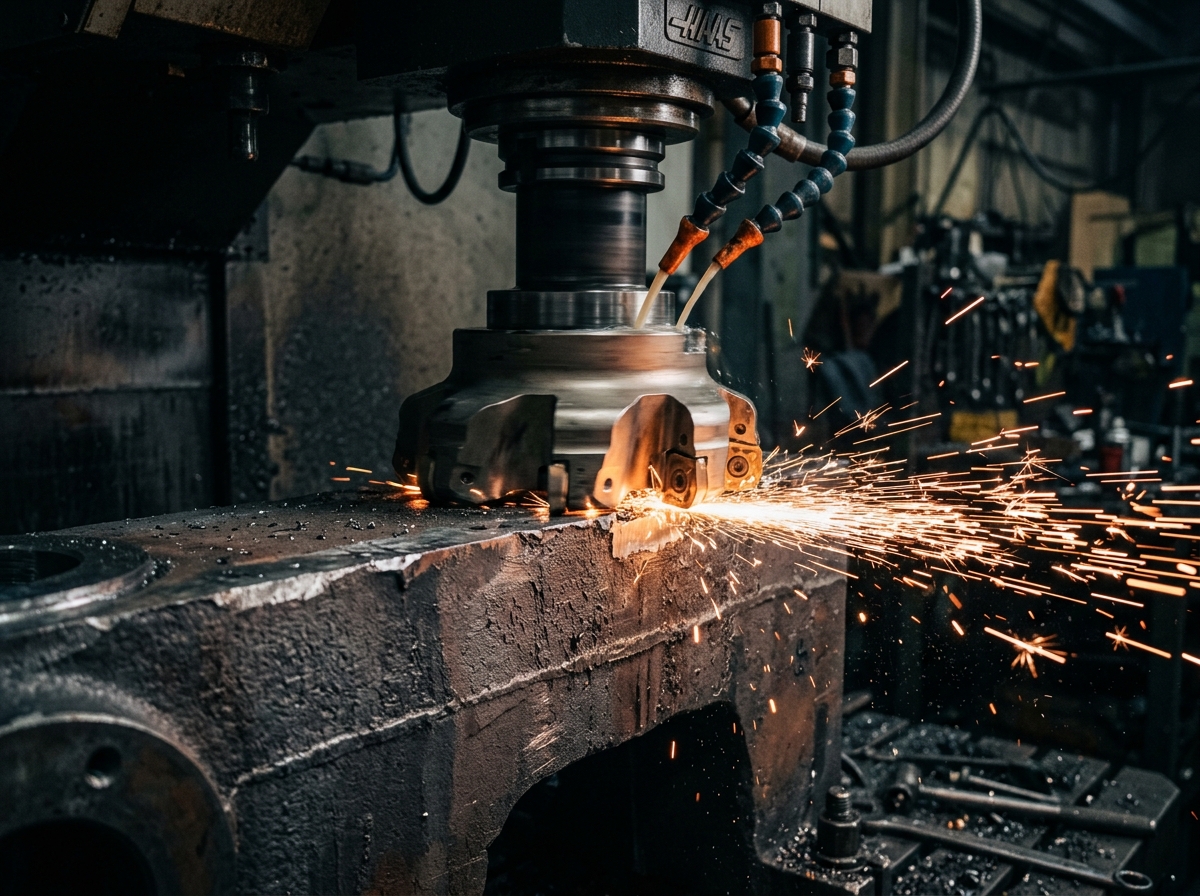
The practical result is that a double column machining centre can maintain close tolerances under heavy cutting conditions that would cause an equivalent single-column machine to deflect. For face milling large machine bases, or boring large bearing housings in heavy castings, this rigidity difference is not a detail — it is the deciding factor in whether you can hold the tolerance.
The SANCO SM-2000s at DHANRAJ Engineering
Our SANCO SM-2000s double column machining centre provides a 2100 × 1000mm table, 2200mm X-travel and 6000 RPM spindle speed with a BT-50 spindle taper. This combination of large envelope and high rigidity is why we can handle components that other machining shops cannot.
The Fanuc 18i-MB controller provides the precision CNC axis control needed to turn that rigidity advantage into consistent dimensional results.
Which Components Benefit Most
Machine bases and bedways, large castings, fabricated structures, bearing housings and any large component requiring flatness, squareness and dimensional accuracy benefit most from double column machining capability. Industries including machine tool, defence, railways, power generation and mining rely on this capability for their most demanding large components.
Tags